
Humans try to disparage life in nature outside the civilisation they have created, thereby digging their own grave.
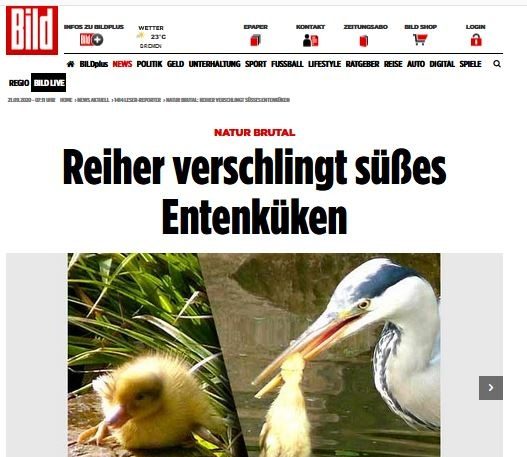
‘Bild’ had its own column called ‘Brutal Nature’
with news items such as this one, headline:
‘Heron devours sweet duckling’.
Denigrating our hunting and gathering ancestors, other free animals and even the entire living world is commonplace in the mass media and other publications. This phenomenon of demeaning all life outside the civilisational system offers a trail that leads deep into the core psychological problem of humanity today. Clarifying and resolving this complex may be the decisive key to a very positive worldview — and perhaps a late chance for humanity’s survival.
In 1848, the explorer Major Mitchell, one of the very few early European settlers on the Australian continent who respectfully devoted himself to the indigenous hunter-gatherers there, wrote about their existence, which he had extensively documented:
‘Such an intensity of existence must, in short, be far beyond all the pleasures of civilised man, beyond anything that the arts could ever bring him’.(1)
Tom Petrie, who spent several years of his youth living among pure hunters and gatherers, learning their languages and getting to know their way of life more intensively than probably any other European, expressed a very similar view. As an old man in 1904, he recalled:
„For them, it was a real pleasure to obtain their food from nature. They were so light-hearted and cheerful, there was nothing to weigh them down.“ (2)
These statements by Mitchell and Petrie do not fit in at all with most contemporary accounts by European colonialists of the existence of the Australian Aborigines. They were usually described as miserable, starving and degenerate. Just how extremely low the new settlers considered the existence of the indigenous people can also be seen in the fact that there were actual hunts in which the ‘savages’ were chased with dogs and shot with guns. In many regions, such as Tasmania, the colonists wiped out the original tribes to the last man.
At first glance, it may seem that the drastic contradictions between the extremely positive testimonies of the natural existence of hunters and gatherers by practitioners Mitchell and Petrie on the one hand, and the unparalleled humiliations by the colonialist system on the other, are something that has long since been overcome. But that is not true.
First of all, even today, it is still quite common, across political camps and other movements, to assume that the entire existence of pre-civilisation cultures was one of being hunted by predators, fear and hunger. In animated films, we learn that before the advent of agriculture, humans fought for their bare survival in a bleak world, constantly looking around uncertainly.
Even more drastically than the existence of human hunters and gatherers in nature, that of other animals is currently being distorted and twisted. This phenomenon can be clearly observed in the largest news magazines on the internet, such as Spiegel Online and bild.de. Because these media outlets use sophisticated analysis tools to precisely monitor which content is popular and which is not, they act as a self-aligning mirror of the collective mind.
What is striking at first glance is that the articles focus almost exclusively on humans, with only a single-digit percentage focusing on other topics. This self-centredness goes so far that even the term ‘world’ is often used when what is actually meant is humanity.
So we write ‘the world is watching New York’ or use the term ‘world hunger’ to refer to human hunger. The few articles that do address other animals fall mainly into a few categories. In one of the largest of these, they are portrayed as ‘cute’ or ‘sweet’ — and thus degraded. Another large category concerns photographic documentation of cases in which individual animals have been rescued by humans and are now photographed framed by protective human hands. A smaller proportion of the coverage is devoted to scientific news from the non-human animal world. And only a fraction of a per cent, and thus virtually no coverage at all, is devoted to the existence of those animals in the system of factory farming — which is, after all, the source of almost all animal food in supermarkets.
In addition to the categories listed so far, there is another one that often occurs most frequently: reports that include photographs of predation scenes in nature. In other words, a dying process that in reality may have lasted only seconds is taken out of its temporal context and presented to the audience as a continuous event. The result — which is also frequently produced in documentary films — is the impression that the existence of non-human animals in nature consists of being eaten for almost their entire lives. The largest German-language news site on the internet, ‘bild.de’, even ran its own section called ‘Natur brutal’ (Nature Brutal) for a long time. There, for example, a photo of a grey heron devouring a duckling was shown, accompanied by the following caption:
‘Heron devours cute duckling. Nature can be so cruel: just a moment ago a fluffy duckling, now merely the main course of a voracious grey heron’ (3).
If you look for it, you will find the same pattern on Spiegel Online. In the ‘Science’ section, there is a ‘Puzzle of the Week’ with the headline ‘Eat or be eaten’. And the text begins as follows:
‘Life is brutal in the wild. An animal mother puts a lot of effort into raising her offspring. Then a hungry predator comes along and snatches one or more of the young animals’ (4).
In order to recognise — as a person who has been prejudiced by the media, so to speak — that there is a contradiction between this artificial image of ‘cruel nature’ and the reality that can be observed in practice, similar to the example outlined above about the Australian Aborigines, it is best to take an unbiased look at a piece of nature that is as uninfluenced as possible. If you initially concentrate on the vertebrates, which are relatively easy to observe, you will soon discover something of great importance that has little place in the world view of civilisation: namely, the fact that free animals in nature exist to a degree that is near to absolute in a state of self-determined development of all their innate characteristics, while prolonged suffering, misery and infirmity are truly rare.
One can also reflect on this indirectly by thinking about how often one has encountered birds — including ducklings — in real nature that have been eaten alive or have suffered in some other concrete way. There will have been only a few cases, the number of which, in relation to the thousands upon thousands of freely developed and healthy specimens, amounted to a fraction approaching zero.
Once the drastic contradiction between civilisation’s distorted image of other animals and their real existence has been recognised in its initial stages, this discovery can be deepened to an extremely interesting level. Numerous empirical findings from neuroscience now prove that cognitive characteristics assumed to be exclusive to humans in the system of civilisation, such as ‘self-awareness’, ‘free will’ or ‘reason’, have no stable basis as such. They were all artificially invented, or they are just as present in other animals as they are in us.
In addition, sensory performance, including the processing processes in the human brain, is below average. Finally, according to irrefutable findings in palaeontological neuroscience, the organic basis for everything related to pleasure and happiness has been fundamentally the same as that of modern humans for at least 500 million years, at least in vertebrates (5).
Once we have discovered the regularity of freedom and the tiny proportion of misery and suffering in nature, and once we have accepted these empirical findings about cognition, we come full circle to the testimonies of Major Mitchell and Tom Petrie: There is now nothing to contradict the idea that other animals have always experienced that ‘real pleasure’ in obtaining their food in the wild. It can be concluded that they were just as ‘light-hearted and cheerful’ as the two practitioners had observed in human hunters and gatherers. And their more acute senses and completely independent existence with nothing but their bare bodies suggest that the intensity of their existence must in fact be ‘far greater than any pleasures enjoyed by civilised humans’.
In reality, for hundreds of millions of years, earthly nature was not only a place of free development, where prolonged suffering and misery were relatively rare occurrences. It was also a place of very intense and conscious experience and enjoyment, light-heartedness and great pleasure.
But why does civilisation refuse to acknowledge this? Nature is nothing less than the entire world. How can it be that humanity speaks as badly as possible about the entire world, cobbling together a completely darkened worldview, instead of recognising it for what it has always been? Why do people do such a thing? And what further causal consequences result from this?
The question of why is easy to answer, but accepting this answer is even more difficult than acknowledging the magnificent and beautiful reality of nature. The answer lies in the fact that the roots of civilisation consist of nothing other than the enslavement of non-human beings.
With the so-called ‘Neolithic Revolution’, humans left behind the paradise of free development and enjoyment in which their ancestors – who exclusively hunted and gathered free animals and plants – had always existed. In order to avoid having to consciously perceive the unnaturalness of the lifelong subjugation of bred and enslaved ‘useful organisms’, they began to distort and demean the entire natural world in such a way that their own unnatural position could be artificially elevated. This began with invented divine commands to subjugate the earth and continues to this day in the mass media. And the price for this was the completely broken and false worldview that all humans now carry in their minds.
Those who manage not only to understand these connections, but also to truly accept them, must first endure some great pain. But this pain does not last forever. And when it subsides, a level of understanding emerges from which an extremely positive world view opens up. It is similar to suddenly discovering a very wide horizon from a hill you have climbed for the first time, in front of which a colourful and beautiful landscape stretches out — which cannot be perceived from the broken ground of the crazy civilisational world view.
And anyone who now wants to take a further step and find out how it can actually be that humanity — despite its quite passable intellectual potential in some fields — seems to be doing everything it can, especially in the present, to destroy the entire natural world and thus its own basis of existence as quickly as possible, now has the answer in their hands: it lies in the intensified psychological problem that has arisen from the increasingly extreme enslavement of other living beings.
It is estimated that today, well over 50 per cent of the biomass of all terrestrial vertebrates on the planet is accounted for by so-called industrial factory farming (6). Admittedly, hardly anyone sees with their own eyes where these huge quantities of yoghurt and sausages, which are piled up in the ever-longer refrigerated shelves of supermarkets, come from. But every single person knows.
That is the crux of the matter. People know that the existence of the animals there, which are very similar to them except for a few details, is determined by nothing but misery and infirmity throughout their entire lives — in other words, the exact opposite of the situation of free animals. And in order to prevent this from coming to the surface of consciousness, the collective subconscious has agreed to turn the entire world upside down instead.
So today’s humans have procured cheap food — in terms of money. But they are actually paying a very high price for it. This ranges from a broken and narrow worldview to serious mental health problems in their children. And the overall causal consequence is ultimately the inability of the entire civilisational system to survive. Such a disturbed collective mind, which revolves only around itself and sees only artificially created gloom around it, cannot appreciate the real world. As a result, it is lost, cannot make the right decisions, has no orientation and no goal, does not know what to do with itself and ultimately perishes from all this.
The key to establishing a healthy self-image and, consequently, the ability to survive can therefore only lie in the immediate dismantling of the escalated perversion of the enslavement of other living beings. Extreme forms such as industrial factory farming must be abolished immediately, from one day to the next. The entire agricultural industry, including the perverse treatment of ‘crop plants’, must be steered towards a massive process of extensification. Every adult has a duty to participate in this. No one can wriggle out of this responsibility. For there is always something that each individual can do to help humanity get back in touch with reality.
(1) Tim Low, Wild Food Plants of Australia, Angus & Robertson
(2) Tim Low, Wild Food Plants of Australia, Angus & Robertson
(3) https://www.bild.de/news/leserreporter/in-freier-wildbahn-12427904.bild.html
(4) https://www.spiegel.de/wissenschaft/mensch/raetsel-der-woche-loewen-schlangen-und-antilopen-a-1046539.html
(5) The vertebrate mesolimbic reward system and social behavior network: a comparative synthesis. O’Connell LA1, Hofmann HA, Institute for Cellular and Molecular Biology, University of Texas at Austin, USA. PMID: 21800319 DOI: 10.1002/cne.22735
(6) Ernst Ulrich von Weizsäcker, Andreas Wijkman u.a. „Club of Rome: Der große Bericht — Wir sind dran“ / Teil.1 Kap. 1.4, Gütersloher Verlagshaus, 2017